Interpreting Specification Section 08 71 00 for Hardware Estimators
A critical translation layer separates spec language from accurate hardware pricing.

Section 08 71 00 tells you what hardware goes on a door. It does not tell you what to pay for it, and that gap is where hardware estimating actually happens. The section is written by an architect, for a design record and a code inspector, and estimators who read it the way it was written miss the translation work that separates a defensible bid from a guess.
How the hardware set system organizes the spec
Every 08 71 00 spec is built around hardware sets, sometimes called groups or types. Each set is a numbered template, a list of every item a given door needs: hinges, closer, lockset, threshold, seals, stop, whatever the opening calls for. Doors with identical hardware requirements get assigned the same set number, so an architect writing a schedule for 300 doors might only need 25 or 30 distinct sets. That's the whole point of the system, from the architect's side. It kills redundant writing.
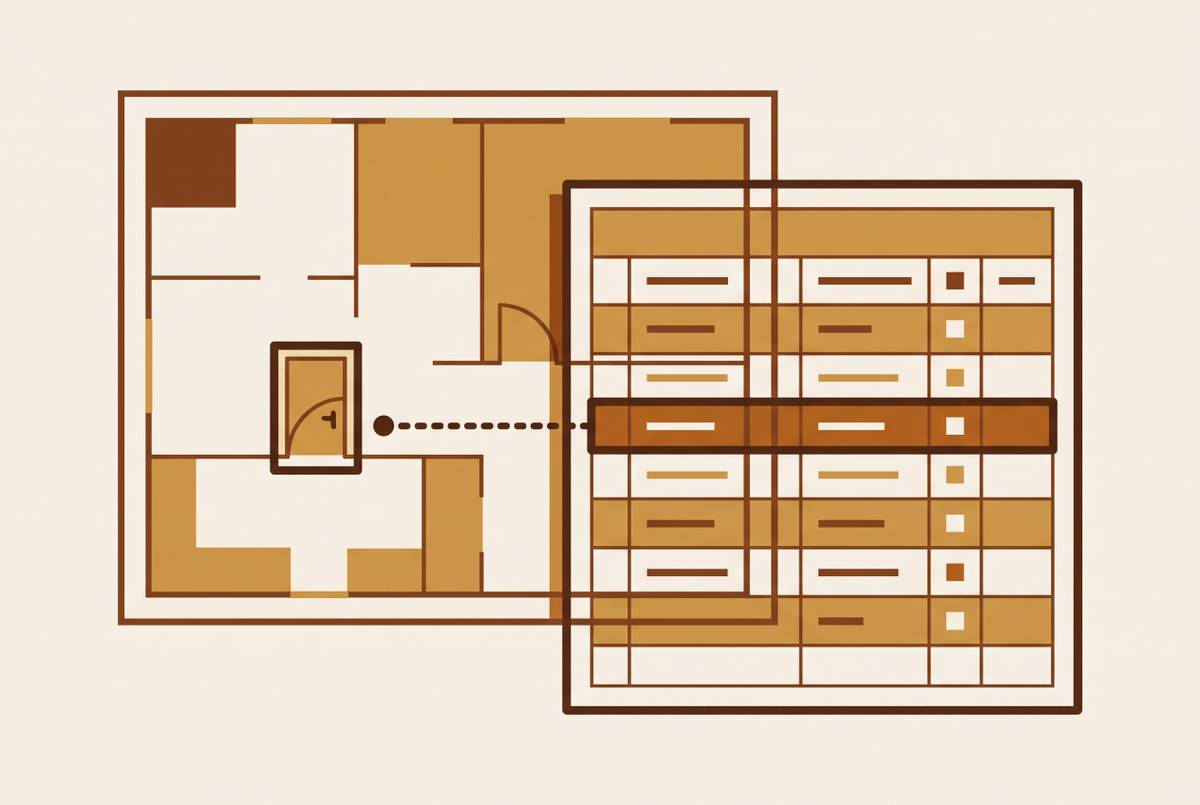
A set number is a pointer. It's a pointer. The estimator has to follow that pointer back to the actual line items, and those items add up fast: the data shows a typical live set runs about 5.8 line items on average, though a roof hatch might only carry 2 and a card-access exterior door can run to 14. So when a door schedule says "Door 101, 3'-0" x 7'-0", hollow metal, 90-minute fire-rated, HW-3," the estimator has to go find Hardware Group 3 in 08 71 00. That's the question. The estimator has to go find Hardware Group 3 in 08 71 00, then confirm it actually matches the opening described, size, rating, frame type, handing, function.
A set is only correct in context. A set is only correct in context. It has to be paired against the door's fire rating, its function (does it need to hold open, does it need panic hardware, is it on an egress path), its frame material, its handing. If someone copies a set number wrong between the schedule and the spec body, or if spec language elsewhere contradicts what the set says, that error doesn't announce itself. The mismatch forms during pricing and award because no one flags the error at that stage, and it becomes visible at submittal review when the AHC catches it, or worse, after the hardware ships. Mismatches between door schedules and hardware specs are a documented, recurring source of delay and change orders on real projects. The estimating discipline here is "does every line in this set match the opening it's assigned to, and is every one of those lines priced."" It's "does every line in this set match the opening it's assigned to, and is every one of those lines priced."
What finish codes, missing data, and undefined abbreviations cost the estimator
Specs have holes in them. Not occasionally, routinely. On one published 233-line hardware specification, 83 items, more than a third of the whole schedule, carried no finish code. Entire categories of hardware carried no finish entry at all. That's not a typo in one corner of the document; it's a structural gap running through an entire category of hardware.
Finish codes also disagree with themselves across documents. US32D is the traditional US finish designation for satin stainless; 630 is the BHMA numeric code for the exact same finish. Both appear in circulation, sometimes on the same project, sometimes in the same spec section written by different hands. Proprietary manufacturer codes that never get defined anywhere in the document leave the estimator holding abbreviations with no key.
Every blank finish is a price somebody has to invent. That's unavoidable. What's avoidable is inventing it silently. The correct move is to price a reasonable finish, write it down as an assumption, and qualify it in the bid, not fold it into a unit price where nobody will ever see the judgment call that produced it. The same logic covers function, size, quantity, and mounting height: any blank field is a decision, and a decision buried in a number is a decision nobody can audit later. Auditing the spec for completeness isn't a separate task that happens before or after takeoff. It has to happen line by line, as each set gets priced, because that's the only point where the gap is actually visible.
Fire ratings, egress requirements, and ADA limits embedded in the spec that directly change what gets priced
Commercial fire doors carry five standard ratings, 20, 45, 60, 90, and 180 minutes, and each rating drags a full set of downstream requirements with it: frame prep, hinge type, closer selection, latching hardware, seal package. Every component in a fire-rated hardware group has to be listed for that specific rating. One non-listed component, a hinge that isn't rated for the assembly it's installed on, can compromise the entire rated assembly.
NFPA 80 governs the inspection side of this, and its checklist (2022 and 2025 editions) is specific: labels present and legible, no unauthorized holes or breaks in the door or frame surface, self-closing devices that actually close and latch. An estimator reading 08 71 00 has to check the hardware sets against these conditions before pricing, not assume the spec writer already reconciled everything.
Egress code sits inside the spec too, and it's non-negotiable regardless of what a set number says. Latches on an egress door can't require more than 15 lbf to release. Locks can't require a key, a tool, or specialized knowledge to operate from the egress side. If a priced hardware set violates either condition, it's wrong, full stop, even if it matches the schedule exactly.
ADA adds its own layer. Interior, non-fire-rated hinged doors can't need more than 5 lbf of force, applied perpendicular to the door, to open. Closers need a sweep period of at least 3 seconds from a 70-degree open position to a point 3 inches from the latch. Thresholds can't exceed 1/2 inch in height, and any level change between 1/4 inch and 1/2 inch needs a bevel no steeper than a 1:2 slope (anything 1/4 inch or under can be a vertical edge). Smoke doors bring a third layer on top of both, with their own hardware and sealing requirements that need confirmation against the hardware schedule before anything gets ordered.
Referenced standards, ANSI A117.1, IBC, NFPA 70, NFPA 80, NFPA 101, NFPA 105, the ANSI/BHMA A156 series, aren't decorative citations sitting in Part 1 General. Every time the spec invokes one, it imports an external rulebook that can override a specific product listed in Part 2. A hardware set that matches the door schedule perfectly but violates a standard cited in Part 1 is still a defective set. Compliance language is a constraint that outranks the product list. It's a constraint that outranks the product list.
How substitution language, approved-equal clauses, and proprietary specs change what the estimator can price
Part 2 is where manufacturers and model numbers get named, and how they're named either gives the estimator room to shop or locks them into a single number. Three patterns occur repeatedly when specifications are written: a named manufacturer with "or approved equal" language, which is genuinely competitive; a named manufacturer with "no substitutions," which is not; and a pure performance spec with no manufacturer named at all, which gives the most flexibility but demands the most judgment from whoever's pricing it.
Institutional owners lean hard on the proprietary end. Institutional specs routinely name specific manufacturers with no-substitution language across closers, operators, and hinges, with any deviation requiring prior written approval and time for review and possible testing before it goes anywhere. Some institutional owners go further, designating specific model numbers as campus standards. The The University of Houston requires keying to run through the UH Access Shop, with construction master keys and cores specified as part of the project itself. Other state agencies similarly impose core type requirements and designate specific internal offices to coordinate keying.
None of that is negotiable at the estimating desk. Every manufacturer reference in Part 2 needs to be read for its constraint level before a number goes into the bid. A "no substitutions" line is a locked cost. Quoting an alternative without going through the approval process is a scope error, and it will appear as a rejected submittal or a rebid, not as savings.
Scope items that live outside 08 71 00 but still belong in the hardware bid
08 71 00 doesn't contain everything the hardware estimator has to price. It references other sections, and those cross-references are part of the scope whether or not anyone flags them.
A VA specification, for instance, cross-references hardware application across a long list of related sections: 08 14 00 Wood Doors, 08 11 13 Hollow Metal Doors and Frames, 08 17 10 Integrated Door Assemblies, 08 41 13 Aluminum-Framed Entrances and Storefronts, 08 42 33 Revolving Door Entrances, 08 33 00 Coiling Doors and Grilles, 08 33 13 Coiling Counter Doors, 08 34 36 Darkroom Doors, 08 34 53 Security Doors and Frames, 08 34 73 Sound Control Door Assemblies, 08 42 29 Automatic Entrances, 08 71 13 Automatic Door Operators, and 08 71 13.11 Low Energy Power Assist Door Operators. Hardware for any of those door types may live in that section instead of in 08 71 00 itself, and an estimator who only reads Division 8 Section 71 00 in isolation will miss it.
Access control adds another layer. Card readers, electric strikes, and power transfers are commonly specified under 28 13 00, Physical Access Control Systems, a completely different division. Those items might never appear in 08 71 00 at all, but the mechanical hardware that interfaces with them, the strike prep, the wiring path through the frame, still belongs in the hardware estimator's scope.
Electrified hardware carries a coordination burden too: wiring diagrams, riser diagrams, interface details with the building's safety and security systems. That's a submittal requirement, but it's also real coordination time and installation labor that has to land somewhere in the bid. The first pass through 08 71 00 should flag every cross-reference to another section and settle, explicitly, whether the item on the other end is in or out of the hardware subcontractor's scope. Whatever gets assumed there goes in the assumptions log. And lead time matters here as much as cost: electrified hardware, automatic operators, and specialty items commonly run 8 to 14 weeks. An item missed during takeoff and discovered after award is a schedule problem, and those are much harder to fix after the fact. It's a schedule problem, and those are much harder to fix after the fact.
How document quality varies across owners
Hardware specs are not standardized the way people assume. Published Section 087100 documents from different owners can require entirely different work: one published 40 hardware sets, another published 23 sets with no finish designations anywhere in the document. Same division, same section number, same CSI format on the cover page, but different jobs sitting underneath it.
Recognizing which kind of document is in hand has to happen before pricing starts, not during it. When no sets are provided, the estimator has to derive them from the door schedule, from whatever product descriptions Part 2 does contain, and from any owner standards that apply, which is a materially larger scope of work than reading a spec someone already finished. When sets exist but are incomplete, every set needs to be cross-checked against the door schedule's fire rating, size, and function to catch what should be listed but isn't.
None of this works without a written assumption log. Every invented finish, every assumed grade, every inferred scope boundary needs to go on paper, because on a project with 300 doors and 15 or more line items per set, the gap between a careful takeoff and a sloppy one is a six-figure number, not a rounding error.
Doors that show up on the floor plans but not on the door schedule deserve their own line in that log. The schedule is frequently out of date, sometimes wrong outright, and an estimator who counts only from the schedule will miss doors that physically exist on the plan set. That's the single most common mistake in a first takeoff: trusting the schedule alone. Plan counts and schedule counts not matching is normal. The failure isn't the mismatch, it's not checking both.
Requirements institutional and owner-standard specs impose beyond ordinary competitive specs
Universities, hospitals, and government agencies frequently maintain hardware standards that sit above the project-specific spec, and figuring out which document actually governs a given product decision is its own piece of work. On a standard competitive job, the estimator extracts what the spec says and prices it. On an institutional job, the estimator often has to author hardware sets that conform to a standard that isn't fully written out in the project document.
One state university requires every project on every campus to conform to its own hardware standards, and requires the spec itself conform to standards that aren't fully written out in the project document. The University of Houston requires keying to run through the UH Access Shop, with construction master keys and cores specified as part of the project itself, and keys and cores supplied and installed by a named vendor as part of the contract, not sourced competitively.
Some institutional specs go further and qualify the supplier as well as the product. Requirements that show up in this research include a hardware supplier maintaining a local office and an active furnishing history in the project's region for at least two years, warehouse facilities on hand, at least one hardware consultant on staff and available for consultation, and status as an authorized factory distributor for every product line specified. None of that is typical on a competitive commercial bid. It's a different category of document, asking a different category of question, and an estimator who reads it with the same habits used on a standard 08 71 00 section will misprice it before the first line item even gets touched.
Sources
- design.missouristate.edu
- cfm.va.gov
- SECTION 087100 - DOOR HARDWARE
- Division 8 Door & Hardware Specifications: CSI MasterFormat Guide | CDF Distributors
- American Locksets. Door Hardware Finish Codes: Complete US and BHMA Guide
- Commercial Hardware Finishes Explained: BHMA and US Finish Codes | CDF Distributors
- U.S. Access Board - Chapter 4: Entrances, Doors, and Gates
- cdfdistributors.com