Electrified Hardware Integration in Division 8 Hardware Sets
Electrified hardware is now standard in Division 8 specs, not an upgrade.

Electrified hardware now appears as a baseline line item in Division 8 scopes for healthcare, education, government, and commercial office work, not as an upgrade tacked onto a mechanical set. Estimators and specifiers who still treat a card reader or an electric strike as a specialty condition are working from an outdated map of the trade.
Electrified Hardware as a Standard Expectation in Division 8 Scopes
Commercial projects across several building types now call for openings that mechanical hardware alone cannot satisfy. A hospital wing, a school administration suite, a government records office, and a multi-tenant commercial floor plate all routinely need electric strikes, electrified locksets, wireless locks, or power-transfer accessories built into the base hardware spec, not added after the fact. The opening itself has changed character: a door with a card reader or biometric scanner tied to a control panel and a software platform is part of a building-wide system, and the administrator managing access permissions from a desk somewhere else in the building is as much a user of that door as the person walking through it.
Even when the hardware category looks the same on paper, the way you use that system shifts by building type. A hotel wants keyless room entry through RFID cards or a mobile app, tied to guest management software that can issue and revoke credentials in real time. A hospital wants credentialed access with an audit trail on restricted clinical zones, where knowing who opened a medication room and when matters as much as keeping the door locked. A commercial office portfolio with multiple sites wants role-based, touchless entry that scales across buildings without requiring a site visit every time an employee changes roles. The hardware category can read identically across all three specs because the functional requirement behind it differs by building type, and that difference has to get resolved before a hardware set can be written.
Once electrified hardware enters the spec, it stops being a standalone product decision. It becomes the starting point for a chain of dependent choices that runs through power, fail-state logic, access control compatibility, and fire and life-safety code, and every one of those choices has to be resolved before the opening is done.
Hardware set structure and placement of electrified components
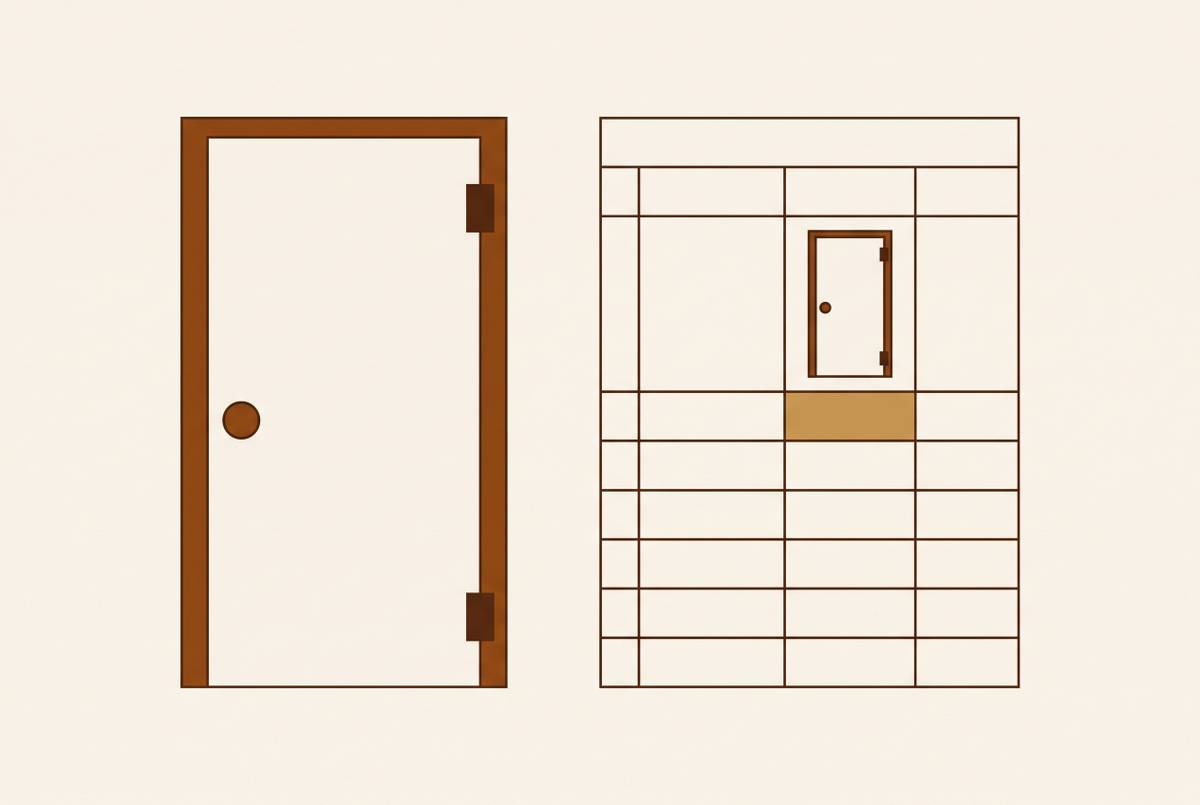
A hardware set is an interdependent package, numbered sequentially (HW-1, HW-2, and so on) and referenced directly by the door schedule, and every door assigned to a given group receives identical hardware. That structure means a single decision to electrify one hardware group doesn't just affect one door; it affects every opening tied to that group number, whether there are two doors on the schedule carrying that group or twenty.
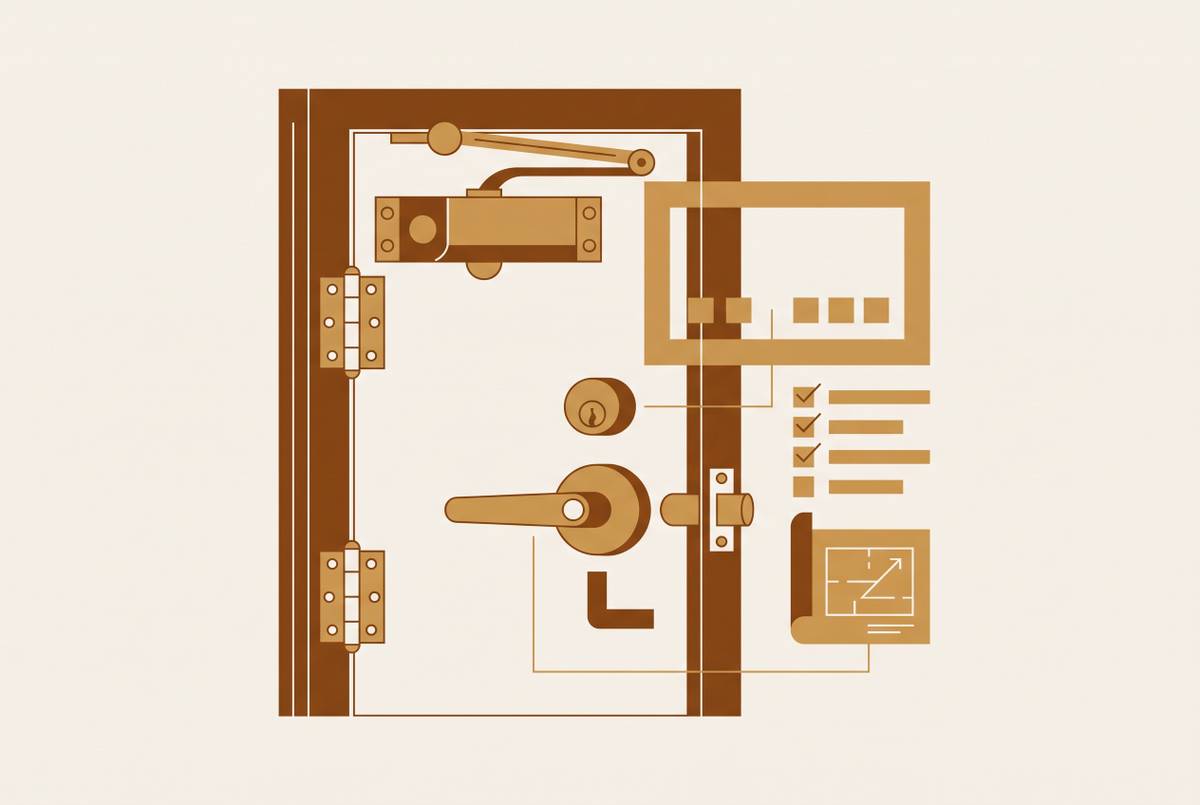
The door schedule is what connects the architectural drawings to the hardware spec. An architect specifies a door by number, size, material, fire rating, and hardware group, and the estimator carries that group number into the corresponding section of the 08 71 00 spec to find out what hardware actually goes into the opening. When that group is electrified, the spec has to resolve every component involved, lock type, power transfer method, door position switch, request-to-exit device, any auto-operator or hold-open magnet, and the power supply itself, before the set can be considered complete. None of those are optional line items once the group carries an electrified designation.
Cornell University's 087100 standard for door hardware requires a door hardware schedule prepared by or under the supervision of the hardware supplier, coordinated with doors, frames, and related work so that size, thickness, hand, function, and finish all align, and it explicitly folds "electrified access control materials" into the scope of Section 08 71 00. A set either accounts for all of that or it doesn't meet the standard.
The practical consequence appears the moment electrified latch retraction enters a hardware set. That door is no longer mechanical. It becomes a systems door, involving power supplies, access control logic, a fire alarm interface, and egress compliance, all at once. If two doors share that hardware set, both get treated as electrified, regardless of whether a card reader icon actually appears next to one of them on the floor plan. The hardware group, not the plan symbol, is what determines the scope. That's the cascade the rest of this piece works through: one electrified decision radiates outward and reshapes every component attached to it.
The component decisions that cascade through an electrified opening
Each component in an electrified hardware set constrains at least one other component. Skipping or deferring any one of them leaves the set incomplete, no matter how complete the rest of it looks.
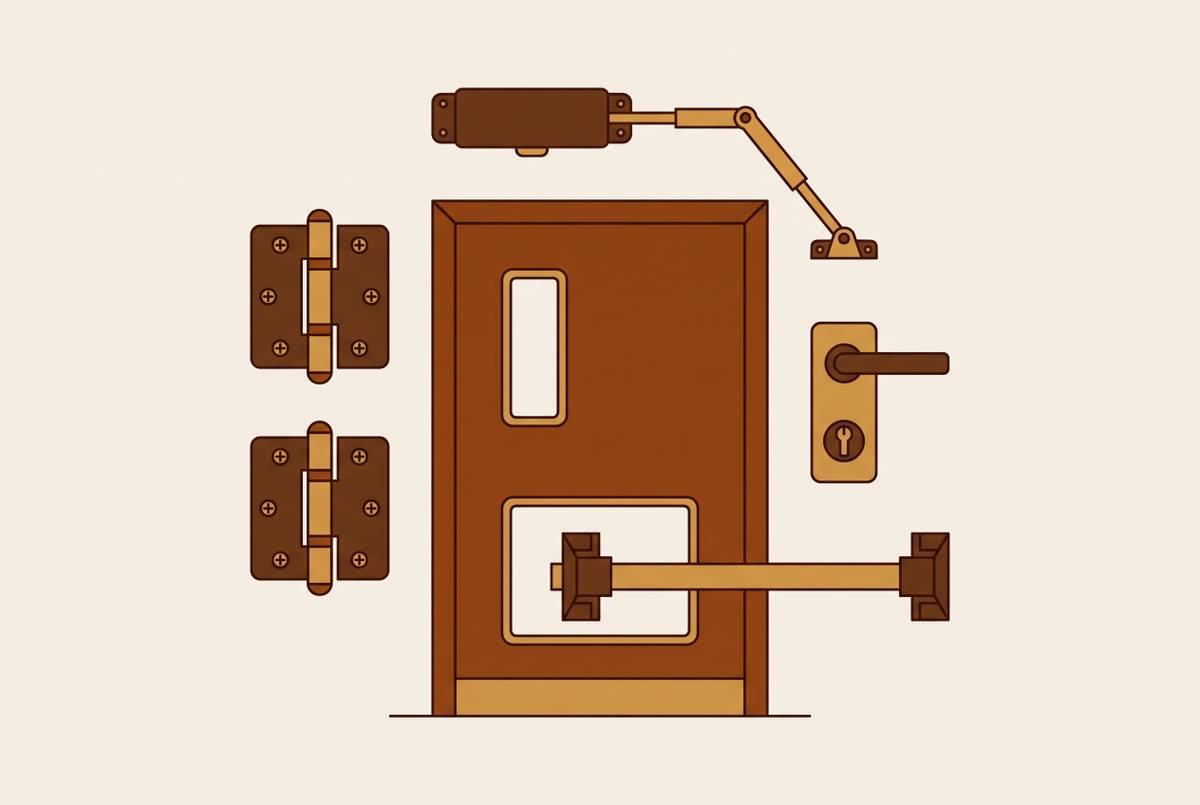
Start with power transfer. If the lock or panic device carries an EL suffix, the spec has to include a means of transferring power across the door's moving parts: an electrified hinge, a door loop, or an electric power transfer (EPT) device. Leaving this out is one of the most common omissions in a hardware schedule, and it's not a minor oversight; the door simply cannot function as specified without it. Product lines built around electrified openings illustrate how many distinct power-transfer architectures exist within a single manufacturer's catalog, spanning electric hinges and pivots, electric mortise locks, electric cylindrical locks, electric exit devices, power supplies, door access controls, and magnetic locks, each representing a different way of getting current from the frame to the moving leaf.
The power transfer method only works once the fail-safe or fail-secure configuration is settled, because the two decisions are linked. Fail-safe hardware unlocks when power drops, so the door opens if there's a power failure or a fire alarm. Fail-secure hardware stays locked when power drops. That choice has to be confirmed with the specifier before a quote goes out, not assumed from habit or from what a similar project used last year. The logic runs from security and life-safety requirements: perimeter and egress openings typically need fail-safe, while secure interior spaces such as pharmacies or server rooms may call for fail-secure. Panic devices on egress paths carry code-driven limits on which fail state is even permissible, so the fail-state decision and the panic hardware decision end up constraining each other. Getting this wrong isn't something a field crew can fix with a minor adjustment; a wrong fail-state selection has to be resolved back at the hardware set stage, which usually means a change order.
The fail-state decision then drives the power supply specification. Every electrified locking device needs a power supply matched to it on voltage (commonly 12V or 24V DC, though some devices run on AC or other DC voltages), amperage capacity, and UL listing. Institutional standards like Cornell's require UL 294-certified power supplies, and major manufacturers such as Schlage build commercial power supply lines around that same certification, with option boards that extend functional capability beyond basic lock operation. Power supplies for electrified latch retraction devices don't have to come from the lock manufacturer; they can be sourced generically as long as they meet the device's voltage, amperage, and UL listing requirements. That sourcing flexibility is also where a lot of scope disputes start, because when the hardware set doesn't spell out the power supply requirements in detail, contractors and suppliers end up arguing over who was responsible for filling the gap.
Request-to-exit (REX) devices and door position switches (DPS) sit alongside the lock and the power supply as their own decision point. REX devices let someone leave through the opening without tripping an alarm; DPS devices report whether the door is open or closed back to the access control panel. Both have to be specified, located, and coordinated with the access control system before the set is final. Distributors frequently bundle REX and DPS into "complete opening" packages precisely because they get sourced piecemeal and missed when they aren't bundled, a pattern that reflects how easy these two components are to overlook relative to the lock itself.
Access control compatibility is the next link in the chain, and it's where a lot of the cascade's consequences land hardest. The lock, the reader, and the controller all have to be validated against the owner's access control platform before the hardware set is written. Compatibility problems are the leading source of friction at commissioning, when a system that looked complete on paper doesn't actually talk to the platform the owner runs. Institutional owners often mandate a specific platform or credential type, and substituting a reader or lock model that hasn't been validated against that platform isn't a legitimate "or equal" substitution, no matter how close the specs look on a cut sheet.
Finally, the fire alarm and life-safety interface closes the loop. Systems can be configured to lock or unlock during a power failure, permit emergency egress, or activate in response to a fire alarm signal, and that interface between the access control system and the fire alarm panel has to be written into the hardware set's sequence of operation. A fire-rated opening carrying electrified hardware has to satisfy NFPA 101 (the Life Safety Code), NFPA 80 (Fire Doors and Other Opening Protectives), and UL 10C (positive pressure fire testing) all at once, and the hardware set has to document that it does. None of these six decision points stands alone. The fail-state choice shapes the power supply choice; the power supply choice shapes what has to get coordinated with the electrical and security trades; and the fire alarm interface sits on top of all of it, because nothing in the chain is finished until the life-safety logic is confirmed.
Testing, certification, and code compliance requirements that govern electrified hardware choices
Every component decision described above is also a compliance obligation, and the hardware set has to document that compliance before it can clear submittal review. Several certification standards apply directly: UL 294 governs access control systems and evaluates performance under electrical interference and tampering; UL 10C covers positive pressure fire testing and certifies that doors and hardware maintain egress capability under fire conditions; FCC compliance applies to wireless components; and the ANSI/BHMA family includes A156.3 for exit devices and A156.25 for electrified locking devices.
UL 294 certification isn't required on every access-controlled opening, but you need it for certain special locking arrangements under NFPA 101 and a model building code, especially in high-security environments where the system has to keep operating reliably under stress. Certified field labeling programs matter here too, because they let a project verify compliance after on-site modifications or repairs, which is relevant anywhere the authority having jurisdiction requires inspection after installation. Regular inspection and proper labeling aren't paperwork formalities; they're what lets the AHJ confirm that a system still performs the way it was certified to perform, and the hardware set has to be written so every component carries its appropriate listing and the full set can be verified as a unit.
Cornell's 087100 standard gives a concrete picture of what that documentation looks like in practice. For every hardware set that includes electronic hardware, the standard requires a "Theory of Operation" narrative, along with detailed system wiring diagrams covering power, signaling, monitoring, communication, and control, and those diagrams have to distinguish between wiring installed by the manufacturer and wiring installed in the field. That's a materially different submittal than a mechanical hardware set requires. A reviewer reading a Theory of Operation document is checking whether the set's internal logic, what unlocks when power fails, what triggers an alarm, how the fire panel interface behaves, actually matches what's written into the wiring diagrams. If a hardware set passes a basic product submittal review but can't produce that narrative, it hasn't met the standard, even when every individual component carries the right UL listing.
The boundary between Division 8 and Division 28
The costliest electrified hardware errors rarely come from a missed component. They come from an unresolved scope boundary between Division 8 (openings) and Division 28 (electronic safety and security), and that boundary is structurally ambiguous in most project documents, not just occasionally unclear. Division 8 typically specifies the door, frame, and hardware, including the electrified lock and the power transfer method. Division 28 typically specifies the access control panel, the wiring, the head-end system, and the security integration. The actual point where one division's responsibility ends and the other's begins, who pulls wire to the door, who terminates it, who commissions the reader to the panel, isn't fixed by any universal convention. It gets decided project by project, and when it isn't decided explicitly, it doesn't get decided at all until someone discovers the gap in the field.
A timing problem makes the ambiguity worse. On many projects, no one selects the Division 28 provider until after Division 8 has already been specified and bid. That means hardware has sometimes been specified, purchased, and even installed before any coordination has happened between the hardware set and the wiring and security components it depends on. A door can arrive on site with an electrified lock, a power transfer device, and a REX sensor all correctly specified under Division 8, and still sit unusable because the Division 28 contractor who has to terminate the wiring and commission the reader to the access control panel wasn't part of the process when the hardware set was written.
A riser diagram for every opening where electrified hardware occurs is one practical response to this known failure mode, not a general best practice offered in the abstract. If you map where wiring will run at each opening before field work begins, electrical engineers and electricians get a shared reference that neither Division 8 nor Division 28 fully owns on its own. The diagram doesn't resolve the scope boundary by itself, but it forces a conversation that the boundary ambiguity would otherwise let slide until the doors are already hung.
Institutional owner standards as an added layer of constraint
On institutional projects, satisfying the project specification is not the same as satisfying the owner. Owner standards exist independently of the spec, and they can override manufacturer, product, and sourcing decisions that would otherwise pass review without issue. Cornell's own 087100 standard requires the door hardware schedule to be coordinated with Cornell's separate Standard 281316 for Electronic Safety and Security Systems. A hardware set on a Cornell project isn't complete when it satisfies 087100 alone. It has to satisfy both documents together, and a set that clears one but conflicts with the other hasn't met the university's requirement.
For an estimator or specifier, that changes what "reading the documents" actually means on an institutional job. The project spec is the starting point, not the finish line. Verifying a hardware set against the base 08 71 00 section is necessary, but it isn't sufficient when the owner has a parallel standard governing the electronic safety and security side of the same openings, and the two documents have to be checked against each other, not just against the drawings.