Go or No-Go Decision Criteria for Division 8 Bid Opportunities
Trade-specific screening protects Division 8 estimators from costly takeoff mistakes.

An estimator clears a generic bid/no-bid matrix, commits the crew to takeoff, and two days later discovers the document set has no complete hardware sets, a sole-source spec with no approved-equal path, and a Q&A window that closed before anyone could ask about either. That sequence repeats across Division 8 shops because the scoring tools most contractors inherit were built for a different trade. Standard weighted matrices cover strategic fit, competitive position, capacity, profit and risk, and strategic value, and every one of those criteria is useful. None of them is specific to Division 8, which is the problem this article sets out to fix.
When a general contractor qualifies a concrete pour or an MEP package, they are not cross-referencing a door schedule against a hardware specification against a partition rating schedule, opening by opening. Division 8 estimators do exactly that, and the ways a Division 8 bid fails are not the ways a concrete or MEP bid fails. A door and hardware shop can score well on a generic matrix that never asks whether the hardware sets are even defined yet, and it can walk straight into a job whose document set will cost the margin before the first frame gets ordered.
The real cost of skipping a trade-specific qualification pass is the better-fit bid that never gets started, because the estimator is buried in takeoff on a job that should have been declined in the first hour. Division 8 takeoffs are unusually labor-intensive to begin with: every opening requires reconciling size, material, frame type, rating, hardware set, handing, and electrified hardware across multiple document types at the same time, which is the exact friction that AI-powered platforms like Fresco are built to remove by reconciling those documents together instead of forcing an estimator to work through them one at a time. A qualification pass that takes a matter of minutes can protect 20 or more hours of takeoff labor. That asymmetry, minutes spent against hours protected, is why you need to build early, trade-specific screening into a Division 8 estimating process rather than treat it as paperwork before the real work starts.
The hard gates that apply to every Division 8 bid before any scoring begins
Before any opportunity earns a weighted score, two conditions should end the conversation on their own: bonding capacity and key personnel availability. The right move is to log it as a gate failure and move to the next pursuit, not to weigh it against an attractive scope or a good relationship with the general contractor.
The same logic applies to staffing. These two conditions are disqualifying conditions rather than low scores on a ten-point scale, and treating them as scoreable criteria rather than gates is how enthusiasm for a project overrides basic arithmetic about who is available to execute it.
Division 8 contributes a third hard gate that general bid/no-bid frameworks typically omit: contract terms that cannot be priced into a unit-price hardware bid. A hard gate at the front end of the process exists so that the scoring framework in later sections has a clean floor to build on, rather than having to account for conditions that should have ended the evaluation already.
Document completeness for a Division 8 bid package
For Division 8, you start pricing hollow metal doors and frames with a document completeness check, not with a takeoff tool. Construction document sets distribute Division 8 information deliberately across multiple sheets and sections: the door schedule, the floor plans, the elevations, and the hardware specification each carry part of the picture, and no single sheet contains the whole scope. A bid package missing any one of these forces an estimator to price gaps that are invisible until the takeoff is already underway.
Bidders are directed to review the complete document set for a reason: the full scope of Division 8 work cannot be determined accurately from anything less than all of it, reconciled against each other. If a package shows up with only Design Development-level schedules and no complete hardware sets defined, that is a named and recognizable pricing risk. Construction Documents is when hardware sets and specialty requirements get added, so a Design Development package can be expected to lack them at that stage. Their absence from a package that claims to be at Construction Documents stage is a gap that will cost estimating hours to chase down later.
An estimator should be checking whether the right information exists at the right stage, not just whether drawings exist. If a package at that stage is missing basic information, size, material, frame type, rating, which should already be established by Design Development, that is a red flag before takeoff starts.
The Q&A window attached to the bid matters just as much as the documents themselves. If the drawings are incomplete and the substitution or clarification window is too short to close the critical gaps before bid day, the risk is structural, and no amount of contingency built into the price will manage it after the fact. Because hardware sets, door schedules, partition ratings, and specifications all have to be reconciled against each other opening by opening, a 30-minute document audit at the qualification stage, confirming that schedules, elevations, and hardware specifications are present and aligned, can protect 20 or more hours of labor: the same reconciliation work that automated Division 8 takeoff software is designed to handle once a complete package is actually in hand.
Reading hardware specification clarity as a risk signal before committing to takeoff
Unclear hardware specification language raises margin exposure in ways the door schedule itself does not capture, and that exposure cannot be recovered once a bid has been submitted. Estimators who fail to distinguish between these two structures at qualification will misprice substitution risk, which counts as a critical and avoidable bid error, not a minor estimating slip.
The ANSI/BHMA A156 series establishes the performance grades that drive product selection and pricing across hardware categories, and institutional specifications often layer UL listing and life-safety requirements on top of those cycle-count grades. At the qualification stage, the relevant question is whether the specification is internally consistent, whether the performance criteria, the named manufacturers, and the fire and UL requirements actually align with each other or contradict one another.
A specification that is internally contradictory, sole-source with no approved-equal path, or silent on performance criteria where performance clearly matters is a pricing-risk signal that belongs in the go/no-go assessment, not in the post-award submittal review where it is far more expensive to resolve. If the Q&A window is too short to get substitution pre-approval before bid day, that risk cannot be resolved at bid time regardless of how it's priced. Reading a hardware spec for this kind of internal consistency is a qualification skill as much as it is an estimating skill, and treating it as one changes when in the process the risk gets caught.
Institutional owner standards and the qualification calculus on large or repeat-owner jobs
Large institutional owners maintain master hardware specifications that govern product selection across every project they build, and these standards are frequently invisible to an estimator who reads only the project-level documents. Universities, public agencies, and healthcare systems routinely publish their own Division 08 71 00 design standards, documents that name acceptable manufacturers, designate preferred brands, and mandate specific tooling as part of the base bid contract, separate from whatever the project-specific architect's spec says.
Cornell University's published Division 08 71 00 design standard shows the pattern clearly. If an estimator prices this kind of job from the project spec alone and doesn't pull the owner's standard, they can miss mandatory tooling line items and may price hinge manufacturers that never made the acceptable list.
Owner standards compress substitution opportunity, and therefore margin opportunity, in a way that is structurally different from a single project-level sole-source spec. On a public project, a school, a government building, a university, specifications commonly name two or three qualifying manufacturers to preserve competitive bidding. The Division 8 specification is written well before the project goes out to bid, so by the time a contractor is awarded the work and ready to order, that spec is the governing document, and any product not specified or already approved as an alternate requires a formal substitution request and architect approval to use.
The qualification question for any institutional job is whether the estimator has obtained and read the owner's master hardware standard, not just the project-level specification attached to the bid set. If that owner standard is not available or has not been reviewed, the bid is being priced on incomplete information, full stop on the logic, not on the risk. An institutional job where the owner standard has not been obtained is not ready to bid. Where the standard has been obtained and the specified products are ones the estimator's supply chain can already source competitively, that counts as a positive qualifier: owner standards reward contractors and distributors who have already built relationships with the manufacturers those owners prefer.
Assessing takeoff burden as a go/no-go input, not an afterthought
Takeoff burden in Division 8 is a function of opening count, document completeness, specification complexity, and electrified hardware scope, and all four need to be estimated at the qualification stage rather than discovered once takeoff is already underway. Every opening is its own small package, door or window, frame, hardware, sealant, trim, and install labor, with each element drawn from a different document type that has to be reconciled against the others. A project with a large number of openings on a clean, complete document set can take less estimating time than a smaller project built on an incomplete schedule, a sole-source spec, and a heavy electrified hardware scope that requires sequencing.
Electrified hardware carries its own labor cost beyond the physical takeoff. When the project documents do not define that sequence, the estimator has to develop it, and that is engineering work layered on top of takeoff work, not takeoff work itself.
Division 8 also runs on two separate workstreams that converge at the opening, creating a capacity risk to check at qualification: hollow metal frames and hardware operate on different lead-time timelines, and frames can arrive on schedule while hardware, often a ten-week lead item, has not even been released yet. A bid package whose schedule narrative ignores that hardware lead-time reality carries mispriced or unexecutable risk that belongs flagged at qualification, before it surfaces in the field months later.
The practical capacity check is straightforward: compare the estimated takeoff hours for a given project against the estimating bandwidth actually available in the bid window, accounting for every other active pursuit competing for the same hours. A project that clears every other criterion but lands during a window when estimating capacity is already committed elsewhere is a scheduling conflict rather than a strategic fit problem, and the right response is to defer it if the timeline allows or decline it if it does not. Firms that do not track their active estimating commitments cannot run this calculation at all, which is itself a process gap that a trade-specific qualification framework exposes.
Scoring a Division 8 opportunity: a weighted framework adapted to the trade
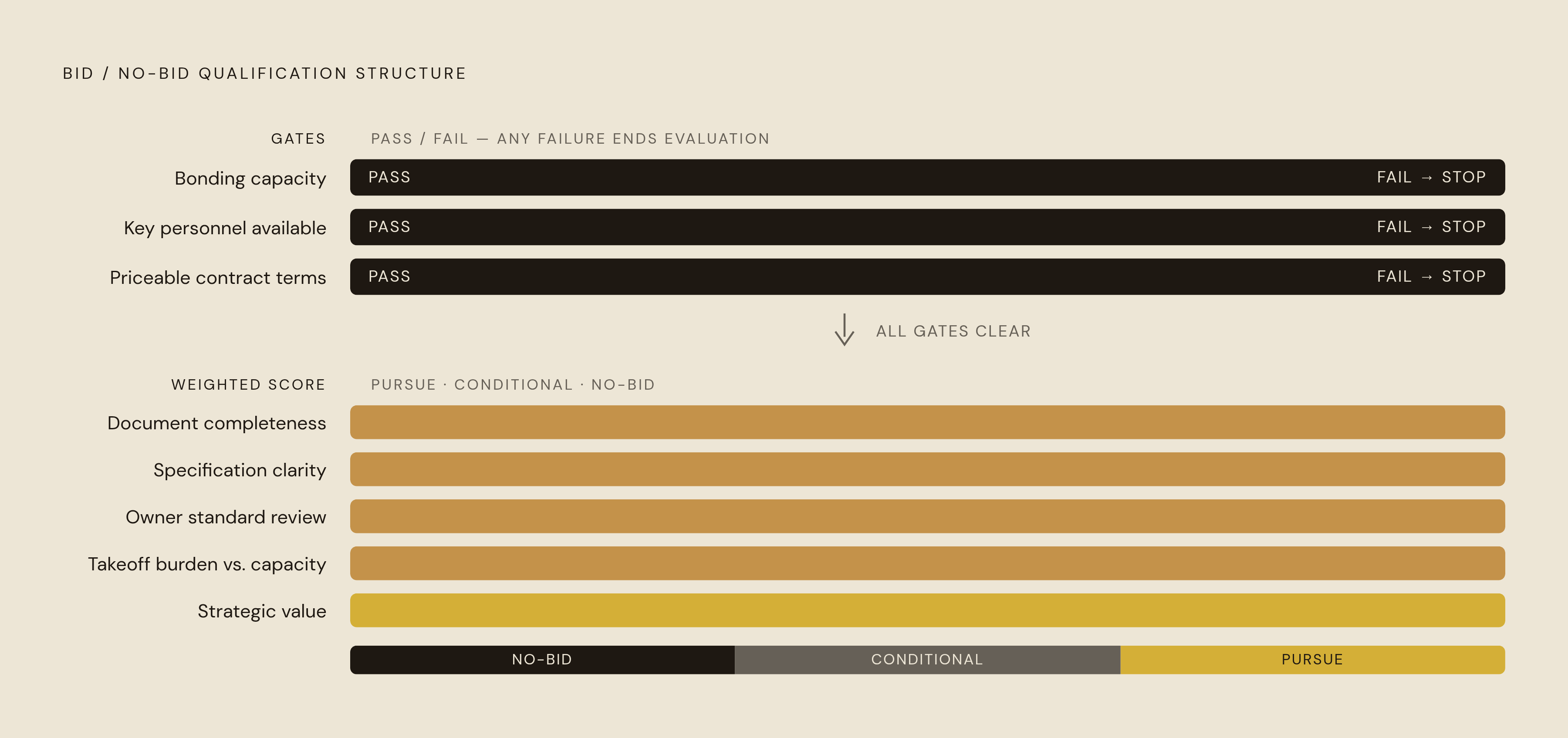
A Division 8-specific go/no-go matrix keeps the structural logic of the general frameworks that most contractors already know: weighted scoring across several criteria, rolling up into a pursue, conditional, or no-bid threshold. What changes is which criteria earn weight. The framework below replaces and supplements the generic categories with the trade-specific ones you built up through the sections above.
Hard gates (pass/fail, scored before anything else): bonding capacity available for this project at this time; key estimating and project management personnel available through the bid window; contract terms, including flow-down provisions, that can actually be priced into a unit-price hardware bid. A failure on any one of these ends the evaluation regardless of how the project scores elsewhere.
Document completeness (weighted criterion): does the package include the full document set, schedule, plans, elevations, and specification, reconciled against each other? Is the Q&A window long enough to close any gaps that remain?
Specification clarity (weighted criterion): is the hardware spec performance-based with named basis-of-design manufacturers, or is it sole-source with no approved-equal path? Is there time in the Q&A window to secure substitution pre-approval if needed?
Owner standard review (weighted criterion, institutional jobs): has the owner's master Division 08 71 00 standard been obtained and read, separate from the project spec?
Takeoff burden against capacity (weighted criterion): estimated hours based on opening count, document completeness, and electrified hardware scope, checked against actual estimating bandwidth available in the bid window, with frame and hardware lead times evaluated as separate workstreams.
Strategic value (retained from general frameworks): relationship with the general contractor or owner, portfolio fit, and reasonable profit margin given the risk profile scored above.
Firms running this kind of checklist manually are reconciling the same schedule, plans, and hardware specification that automated Division 8 takeoff platforms, Fresco among them, are designed to read simultaneously and flag for disagreement. The scoring framework above does not replace that reconciliation work. It decides, in minutes rather than hours, whether a given opportunity is worth the hours that reconciliation will take.