Phased Construction Document Sets and Division 8 Takeoff Complexity
Phased documents force estimators to reconcile door hardware across time, not just across sheets.

Division 8 takeoff, the estimate for doors, frames, hardware, and glazing, breaks down when the documents that describe an opening arrive at different times and disagree with each other. Phased construction document sets, where design development packages, permit sets, and later addenda get issued on separate schedules, turn a hard reconciliation job into a layered one, and the resulting conflicts often hide in plain sight until the bid is already submitted.
Reconciliation requirements for a standard Division 8 takeoff
Division 8 in CSI MasterFormat covers "Openings," which sounds narrow until you count what falls under it: doors, frames, windows, storefronts, curtain walls, and the hardware that ties them together. A mid-size commercial project can carry anywhere from 180 to more than 400 individual door openings, and each one comes with its own fire rating, frame type, hardware set, and ADA clearance requirement. Get one wrong on a handful of doors and it's a rounding error. Get the hardware set wrong across a big chunk of them, and on a 300-door job the cost swing between a careful takeoff and a careless one can run into six figures, since a single hardware set can carry 15 or more line items (hinges, closer, lockset, panic device, wall stop, and so on).
The workflow itself is fairly linear on paper. An estimator reviews the drawing set and specs, walks the floor plans level by level and zone by zone, sorts openings by type and material, counts hardware sets opening by opening, applies fire ratings and code requirements, prices everything against current vendor data, and then runs a QA pass against the schedule totals. Door schedule reconciliation, checking counts against both the floor plans and the architectural door schedule and flagging anything that doesn't line up, isn't optional even on a clean set issued all at once. Hardware itemization has to be organized by set number, with hinges, closers, locksets, panic hardware, and specialty items each broken out.
Three failure modes appear in nearly every project, phased or not. First, working from a superseded hardware schedule: if a revision came out and nobody caught it, the estimate prices hardware that's already been changed. Second, assuming "similar" means "same." A door noted as "similar to Set 3" is not Set 3, and finding the actual difference is the estimator's job, not a detail to skip. Third, missing hardware prep coordination, like a mortise lockset specified for a door that's only prepped for cylindrical hardware. That one tends to appear during installation, long after the estimate is locked in. That timing is what makes it expensive.
Phased document issuance and layered reconciliation problems
Phasing splits a project into sequential or overlapping stages, and phase stacking, starting procurement while permitting is still underway, deliberately overlaps document releases to save time on the schedule. That's a reasonable move from a project management standpoint. It's also the reason Division 8 takeoff gets harder, not easier, as a project moves forward.
Industry sources describe the construction documents phase as comprehensive, then turn around and admit that calling a CD set "fully complete" is somewhat misleading once you look at how projects actually run. On a phased set, the door schedule that came out with an early design-development package may not reflect the hardware spec issued weeks later with the permit set. Neither document is wrong on its own. Each new issue can quietly supersede details in an earlier one, and an estimator working document-by-document has no built-in way to know which details changed unless they go back and reread everything they already reviewed.
That's the core of the layering issue. A single-issue set asks the estimator to reconcile documents against each other. A phased set asks the estimator to reconcile documents against each other and against time, since the same opening might be described three different ways across three different issue dates, with no single document flagging that the other two are out of date.
Three conflict patterns unique to phased sets
Set number drift is the most common one. It's already a known headache on a single-issue set when a hardware set gets referred to as "SET 4" in one place, "#4" in another, and "HW-4" in a third, all meaning the same thing. Phasing adds a second axis to that mess: the same set can get renumbered entirely in a later issue, with no supersession notice tying the old number to the new one. The estimator ends up reconciling two numbering systems across two document dates, and normalizing set references, already a manual burden on a clean set, becomes a job with no clear starting point.
Electrified hardware carries its own risk, and it's easy to under-carry in a fast bid under any conditions. Power transfer hinges, access control components, proximity readers, these get missed even on single-issue sets. On a phased set, the specific danger is that hardware sets priced from an early document issue may not reflect electrified items added or clarified in a later spec release, and an estimator who has already priced the earlier issue may never go back to revisit those sets. Spec lines that cite a model number "available by phone," or that specify neither amperage nor voltage, aren't fixable by careful reading. They need an RFI, full stop.
Scope boundary confusion is the third pattern, and it occurs on divided-scope items where supply and install responsibility gets clarified in stages. An "OT" (other trade) notation in a hardware set might be accurate as of Phase 2, but it can reflect a scope split that was different in Phase 1. The City of Santa Fe Fire Station No. 2 spec, Section 087100, is a documented real case of how granular this gets: out of 34 live hardware sets, ten hand off a line item as another trade's scope. Exclude the wrong ones from a bid and there's a hole in it. Include the wrong ones and the bid double-counts scope that's already sitting in another subcontractor's price.
The same Santa Fe documentation shows four doors assigned to two hardware sets simultaneously, and nine doors assigned to a set explicitly captioned "(NOT IN USE)." The same Santa Fe documentation shows four doors assigned to two hardware sets simultaneously, and nine doors assigned to a set explicitly captioned "(NOT IN USE)." On a phased set, a door can carry forward an assignment to a set that a later issue eliminated, and with no visual indicator in the schedule marking that the assignment is outdated, the estimator has to already know the set is dead to catch it.
Why a document-by-document manual process cannot catch cross-issue conflicts
The standard manual approach reads documents in sequence: plans, then door schedule, then hardware schedule, then the Section 087100 spec, each one checked against notes already taken from the document before it. That sequence works fine when every document in the pile was issued on the same date. It breaks down the moment two of those documents were issued weeks apart and contradict each other, because a sequential process has no mechanism for catching a conflict between Issue A and Issue B unless the estimator is explicitly tracking which version of every detail came from which issue.
In practice, that tracking rarely happens with any rigor. A hardware schedule on an active project can go through several revisions, and a common failure mode is an estimator pricing from an earlier version without confirming it's still current. Industry guidance on phased bids is clear about the correct process: reconcile schedules and specs against each other, review every non-standard opening individually, identify every divided-scope item, and document anything unresolved through an RFI or a written qualification before the tender goes out. That's the right answer. It's also a description of several additional days of work on a large project, work that a document-by-document read-through was never built to include.
A structured pre-bid reconciliation process on a phased set
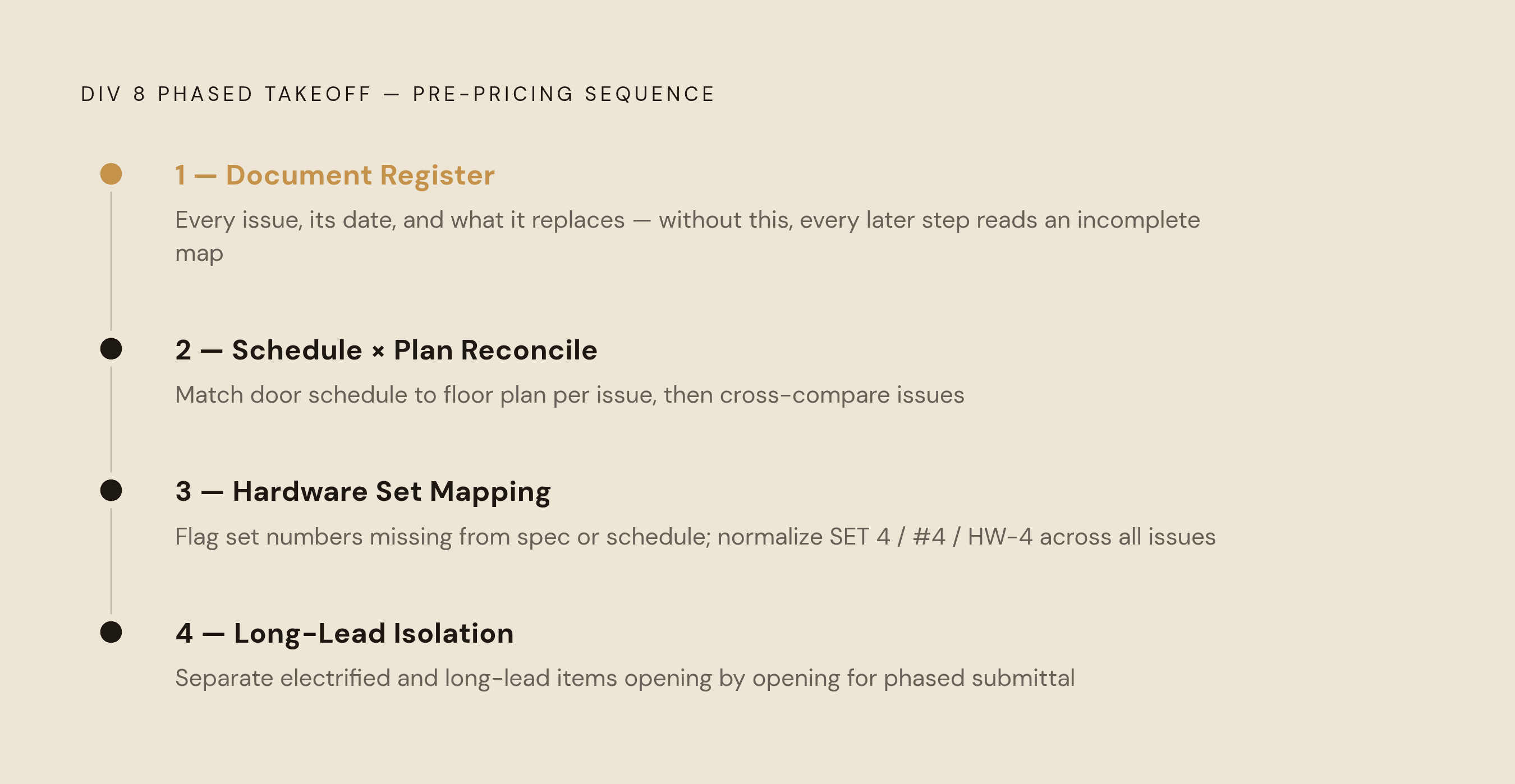
The fix starts before anyone opens the door schedule. Step one is building a document register by issue date: every document in the set, its issue date, and what it supersedes, logged before any quantities get pulled. The real reconciliation surface on a phased project is the relationship between issues, not the documents in isolation, and skipping this step means every later step is working from an incomplete map.
Step two is reconciling the door schedule against the floor plan for each issue on its own, and only then comparing issues against each other. Doors that were added, dropped, or reassigned between issues need to get resolved explicitly, not absorbed silently into whichever version happens to be sitting on top of the pile.
Step three maps hardware sets across every document issue, flagging any set number that shows up in the door schedule but not in the current hardware spec, and vice versa. Set references need to be normalized across naming conventions before any matching starts, otherwise "SET 4" and "HW-4" get treated as two different sets when they're the same one.
Step four isolates long-lead and electrified hardware items opening by opening, separating them from routine openings so early procurement or phased submittals can get flagged cleanly. This step only works if the takeoff already knows which phase each opening belongs to. It comes last, after the document register and the cross-issue mapping are already in place.
AI takeoff tools and phased document sets
AI moved into construction estimating in a real way during 2025, particularly around takeoff, document handling, and issue detection, and adoption among the top 100 general contractors crossed the 60% mark sometime that year. The productivity numbers being cited are notable: takeoff time cut by 70% to 90%, with accuracy above 95% on standard commercial and residential plans. The word doing the work in that sentence is "standard." A phased document set, by definition, is not one.
Current Division 8-focused tools handle clean sets well. Software in this category can pull a door schedule, hardware schedule, and floor plan openings into a single reviewable takeoff, price it, and export the result, flagging plan openings that never made it onto the schedule and schedule rows with no matching opening on the plan. Some tools go further and normalize set references automatically, resolving "SET 4," "#4," and "HW-4" to a single set before any matching happens. Others extract door schedules and hardware sets directly from plans and specs, tag doors by configuration, and support plain-language mass edits, changing every 90-minute-rated opening on a given floor to a specified hardware set with a single command. AI-driven takeoff platforms elsewhere in the market return count quantities for doors and other openings straight from digital plans, and at least one AI detection tool on the market reports high accuracy for doors, windows, rooms, and walls relative to a manual baseline.
None of that reaches the challenge of phased sets described above. Every one of these tools ingests a document set as presented to it, extracting what each document says. The cross-issue conflict, where the door schedule from one issue contradicts the hardware spec from a later one, requires software that understands which document version governs a given field, not merely software that can read the field accurately. Until takeoff tools carry that kind of version awareness, the layering issue stays a human responsibility, and the structured, issue-by-issue reconciliation process described above remains the only reliable way to catch it before the bid goes out the door.