Keying Schedule Development for Large Commercial Projects
Resolve door schedule conflicts before the keying schedule begins.
A keying schedule that fails traces back, almost without exception, to a document upstream that was incomplete or internally contradictory. The schedule itself is a detailed specification listing how all cylinders are to be keyed, plus quantities, markings, and shipping instructions for all keys and cylinders to be provided. It is the terminal point of a coordinated Division 8 document chain, not a starting point.
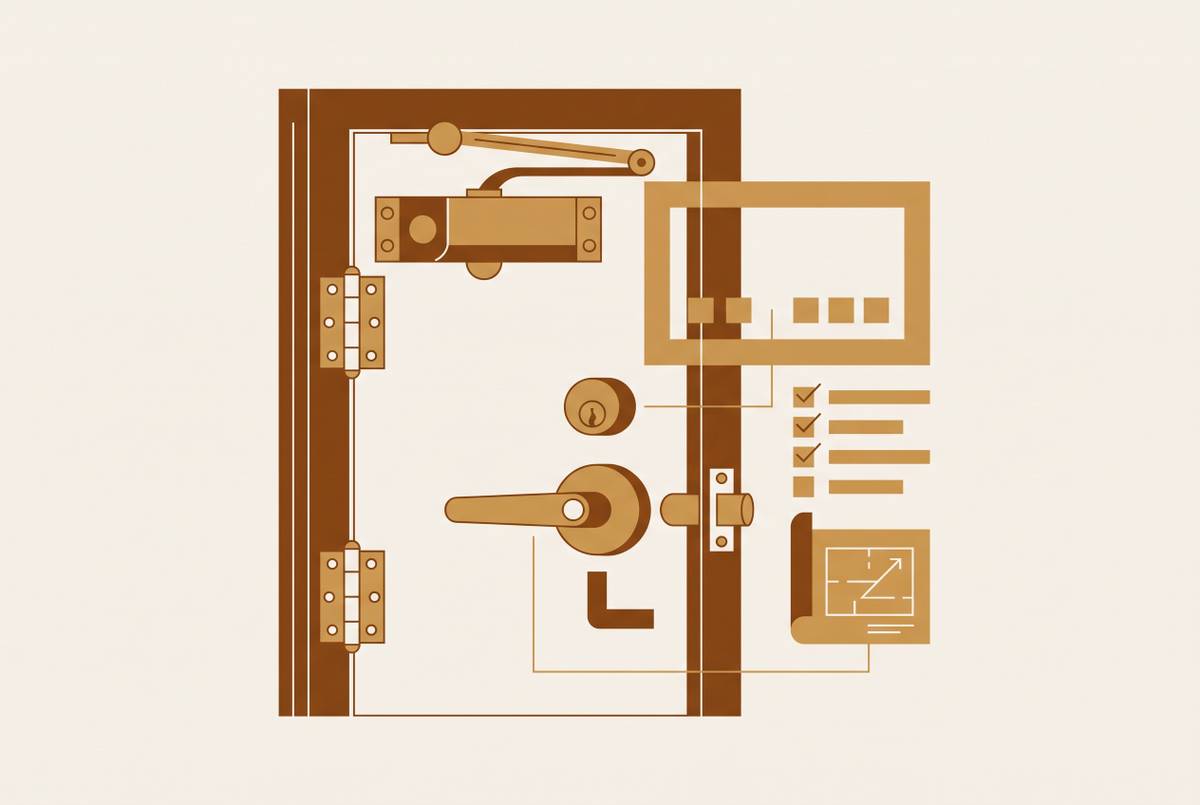
That chain runs from construction drawings through the door schedule, through hardware groups in the 087100 specification, and terminates in the keying schedule. Each document depends on the accuracy of the one before it. A large commercial project can have hundreds or thousands of openings in the door schedule. Catching them requires reading the documents together, not in sequence, because a conflict is only visible when the two documents sit side by side.
How the door schedule anchors every downstream keying decision
The door schedule is the bridge between the architectural drawings and the hardware specification. Its completeness determines whether the keying schedule can be built accurately at all, because every opening that will receive a cylinder first appears as a line item in this document. The architect records a door as, for example, "Door 101, 3'-0" x 7'-0", hollow metal, 90-minute fire-rated, HW-3." The hardware distributor then turns to Hardware Group 3 in the 087100 specification to determine what hardware applies. That lookup only works if the door schedule is accurate, because every discrepancy between the schedule and the actual opening will surface later as a keying conflict.
Some pitfalls are common enough to flag explicitly. Mismatched leaf, frame, or glazing labels versus the required fire rating will produce an opening that cannot accept the specified hardware. Wrong handing, or an active leaf with a missing coordinator or astragal, changes which cylinder and strike geometry the opening needs. If electrified hardware has no power transfer, or the wrong fail state, the opening looks complete on the schedule but will not work. Each of these will surface as a keying conflict if it is not caught at the schedule stage, and by then the fix is no longer a document edit but a reordered cylinder or a repinned lock.
Use the status workflow in the schedule to track which openings are resolved and which remain open questions before the keying schedule is submitted. The workflow moves from Planned through Submittal, Approved, Fabrication, Installed, Punch, and AHJ Pass. An opening sitting at the wrong status is a signal that the data behind it is not yet dependable, and the keying schedule should not inherit unresolved entries as though they were final.
How hardware groups translate door schedule data into keying logic
Hardware groups are the organizing logic of the keying schedule. Every keying decision traces back to which group a door belongs to and what that group specifies. The groups are numbered sequentially: HW-1, HW-2, HW-3, and so on, referenced by the door schedule. Doors in the same group all get the same hardware, down to the cylinder type and keying tier. That last point is the one that matters most for keying: a hardware group is not merely a product list but a keying unit. Every door in the group will key alike unless the group is intentionally subdivided, which means the granularity of the keying hierarchy is decided here, at the grouping stage, rather than later in the keying schedule itself.
A hardware consultant assigns groups based on the door's function, location, fire rating, accessibility requirements, security level, and traffic volume. Fire-rated groups must be handled separately in any case: the standard commercial fire ratings each impose specific requirements on closing devices, latching hardware, and cylinder compatibility. A cylinder that is not listed for the applicable fire rating produces a failed inspection, not just a keying error, and that failure arrives at the very end of the project when correction is most expensive.
The DHI's Sequence and Format for the Hardware Schedule is the industry standard for hardware schedules. You see the same sequence and format in Division 08 specification documents, where it organizes hardware sets. If you use this sequence during group development, the keying schedule inherits the same ordering logic.
What the 087100 specification must establish before keying work begins
The 087100 specification is where the keying system's parameters are declared. Before any hierarchy can be designed, the spec must establish the keyway, whether proprietary or standard, the number of master key levels in the hierarchy, the key control method, who maintains key system records, and whether construction cores will be used. If the keyway designation is missing or the control method is undefined, you cannot design the hierarchy yet, no matter how complete the door schedule is.
Construction cores are a distinct operational requirement. They allow the building to be secured during construction under a temporary key system that is replaced at turnover, and this must be specified explicitly or it will not be included in the submittal. That matters because a construction core system needs its own partial hierarchy and its own transition plan, and you do not get either by default.
The specification also governs acceptable manufacturers for each product category, and this shapes which cylinder families are available for the keying system. On institutional and large-campus projects with multiple buildings, you often need a patented keyway with restricted key duplication and a key control policy that facilities manages. That is a spec-level decision that cannot be retrofitted after cylinders are ordered, because the patented keyway and its restricted duplication depend on the manufacturer's key control infrastructure being in place from the first pinned cylinder.
How institutional owner standards reshape the keying schedule before the project goes to bid
On institutional projects, the owner's published construction standards govern what the 087100 spec can specify. Ignoring them at the bid stage produces a keying schedule that the owner will reject at submittal, because the standards operate as a constraint above the project specification. They fix decisions that a private project would leave open to the design team.
The University of Iowa Hospitals & Clinics supplies the clearest example. Their standards specify individual product designations, including that keying final shall be Medeco X4, which is owner supplied. A bid that assumes a different cylinder family is disqualified on its own terms, no matter how well executed the rest of the keying design might be.
Michigan DTMB government hardware standards, updated April 2025, impose requirements on who may execute the keying work. The distributor must be located within a defined radius of the project and be a factory-authorized dealer for all required materials. Both requirements affect who can execute the keying work, not just what they supply, which means they constrain the bidder pool before the keying hierarchy is ever discussed.
Healthcare environments add regulatory layers on top of owner standards. The 2026 FGI Codes for Planning and Design set minimum requirements for regulatory compliance and facility safety, starting with the 2026 edition. ANSI/BHMA Grade 1 hardware is required for institutional and heavy-traffic applications. This is not a preference but a baseline for any institutional keying system, since lower-grade cylinders will not pass the testing thresholds these owners enforce.
Mapping the keying hierarchy zone by zone across the project
To build a keying hierarchy for a large commercial project, you zone the building. The document chain provides the openings. The hierarchy design assigns each opening to the correct level of access control, and the way to do that is to work through the building as it will actually be operated, floor by floor and department by department.
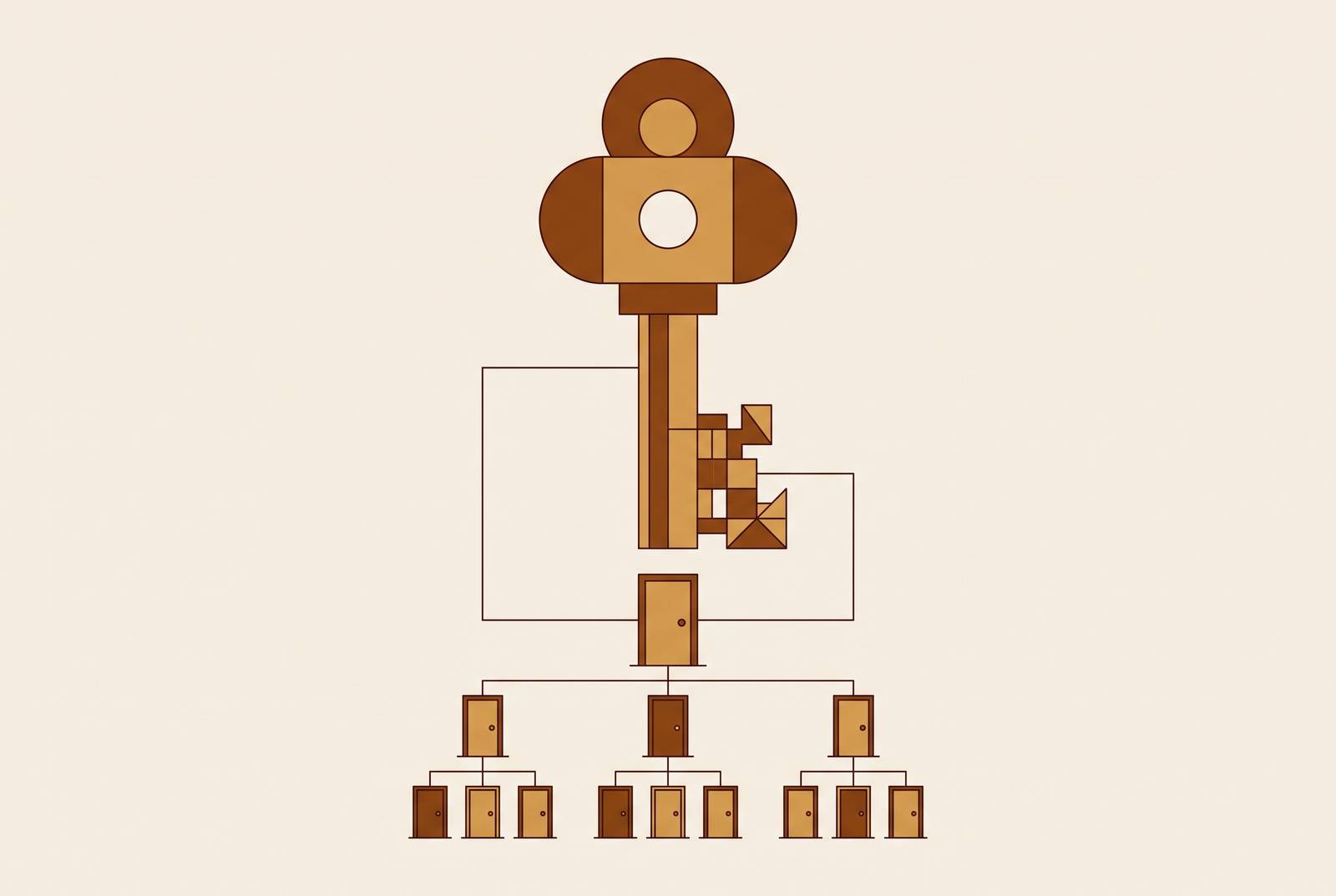
The structural logic begins with the master key levels. A Grand Master Key opens all locks in the master-keyed groups beneath it. In larger systems, a Great Grand Master Key sits above the GMK and opens all locks in its GMK groups, and in very large systems it is the top-level key across multiple GMK systems. Below these, individual change keys serve specific openings or groups. The design task is to place each opening at the correct level so that each level above gives access to everything below it in its zone, but not across zones.
With the zone-by-zone approach, you assign each hardware group to a key level based on the operational requirements the owner has defined. Individual offices or suites key at the change key level. Common area access, emergency access, security zoning, and construction-phase access are all distinct zone types that require distinct key assignments, and they must be mapped separately rather than collapsed into a single hierarchy.
Emergency access is a distinct design constraint within this exercise. Life-safety openings, fire stair doors, and AHJ-required egress paths may need to be keyed to a separate emergency master that crosses zone boundaries, because an emergency responder's key must open openings that the normal zoned hierarchy deliberately keeps separate. You must identify this in the hierarchy design before cylinders are pinned, not discover it during inspection. If the spec includes construction cores, the construction-phase keying system must be mapped separately, and the transition plan, when construction cores are replaced with permanent cores and who holds the construction master, must be documented in the keying schedule.
The keying conference as the formal checkpoint where the hierarchy is locked
The keying conference is a discrete project milestone, not an informal meeting. It is where the hardware distributor, building owner, and locksmith align on the hierarchy, and no cylinders should be pinned before it concludes. At the conference, you define the master keying hierarchy, individual key assignments, and control key distribution. These decisions become the pinning instructions, so an error in this meeting becomes hardware you must reorder.
Each attendee brings a distinct responsibility. The output of this alignment is a keying schedule that is submitted separately, often directly by the lock manufacturer to the owner's facility manager, for approval before cylinders are pinned. That submission is a formal approval step, not a courtesy review.
Lead times make the timing of this conference a critical path constraint. So schedule the keying conference early enough that its output can be submitted and approved within the procurement window. If the timing is wrong, the project's hardware critical path may not be manageable at all.
Where electrified openings and access control create gaps in the keying schedule if not planned explicitly
Electrified openings must be resolved in the keying schedule just as mechanical openings are. An opening that has a card reader or an electrified lock still has a cylinder, and that cylinder must be assigned to the hierarchy. The assumption that an access-controlled opening does not need keying is the most common way a keying schedule develops a hole.
The full scope of an electrified opening includes card readers, electrified locks, electric strikes, magnetic locks, power transfers, request-to-exit devices, door-position switches, and power supplies. Each must be assigned a clear supply and installation responsibility between Division 8, Division 26, and Division 28 before the keying schedule is submitted, because the cylinder's place in the hierarchy depends on how the entire opening is powered and controlled. Fail-safe, unlocked on power loss, and fail-secure, locked on power loss, are different operational conditions, and the fail state determines whether the opening needs an emergency key override and at what level of the hierarchy that override key must operate.
You may think an opening with a card reader or access control credential needs no keyed cylinder at all. The keying schedule must document this explicitly or the override cylinder will simply be omitted from the cylinder order. A gap here produces a door that is physically installed but not commissioned by occupancy, and the keying schedule that omits this coordination is the document that allowed the gap.
How working through the document chain early changes what the keying schedule costs and how long it takes
If a hardware distributor engages the document chain at or before the bid stage, they can spot specification conflicts, flag owner-standard constraints, and draft a keying hierarchy before award. When the distributor engages early, they can review the Division 8 specification, see what is required, flag issues or opportunities, and prepare a bid that is accurate and complete. Every conflict caught at this stage is a change order that does not happen after award.
The practical benefit of reading door schedules, hardware sets, and the 087100 spec simultaneously rather than in sequence is that conflicts between documents surface before they become pinned cylinders, fabricated frames, or failed inspections. Estimating tools that bundle hardware per opening rather than as loose line items, and that pull data from multiple document types simultaneously, produce the accurate, opening-by-opening picture that a keying schedule requires. A count-and-price approach applied to keying systems produces a hierarchy with holes in it, because the keying logic lives in the relationships between documents, not in the total count of cylinders.
The keying schedule is submitted for approval before cylinders are pinned. Every rework after that point, whether repinning cylinders, reordering restricted keyways, or revising key quantities, carries lead-time consequences that can push the project's occupancy date. A slow, manual reconciliation process is not just an accuracy problem. It is a capacity problem that limits how many jobs can be quoted in a cycle, and that limit is the hidden cost of treating the keying schedule as a document that begins where the others end.