Specialized vs General Estimating Software for Doors Frames and Hardware
Specialized software catches hardware conflicts general tools miss.
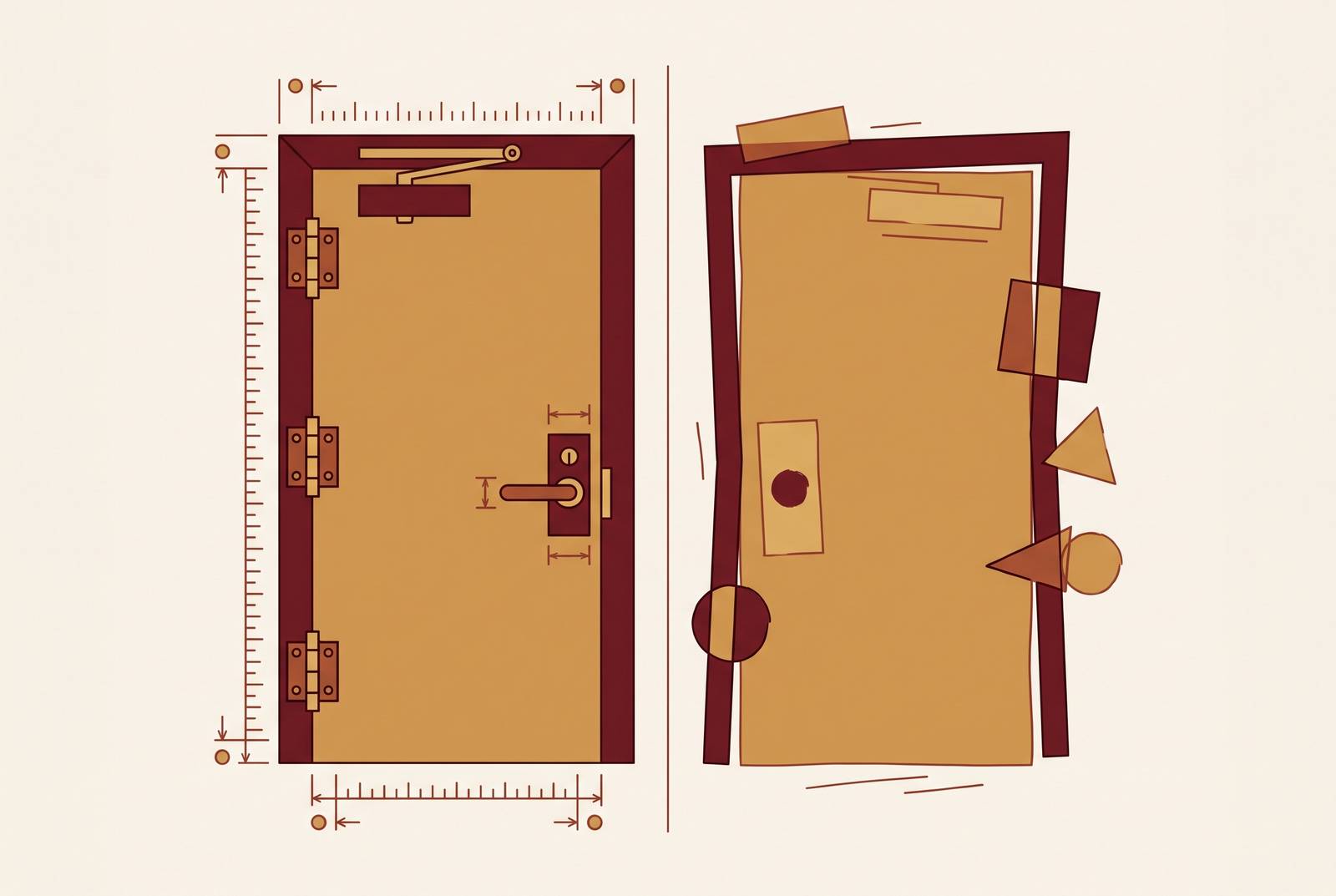
Consider a single line on a door schedule: Door 101, 3'-0" by 7'-0", hollow metal, 90-minute fire-rated, assigned hardware group HW-3. That one line does not tell an estimator what to order. It tells the estimator where to look next. The schedule assigns the opening to a hardware group, and the estimator has to pull the full hardware list for that group out of the 08 71 00 specification: hinges, lockset, closer, stop, seals, threshold, and any specialty items the group calls for, then check all of it against what the schedule and the drawings actually show. A Division 8 estimate reaches completion only when every opening on the job has gone through that same reconciliation, checked across the door schedule, the hardware sets, the 08 71 00 spec, the floor plans, and whatever electrical or consultant drawings touch that opening.
Five document types can govern one door at the same time: the door schedule, the hardware specification, the floor plan, the door elevation, and the electrical or power plan where the opening carries an electrified strike or access control. None of those five documents is self-sufficient. The floor plan shows where the door sits and which way it swings, not what hardware it carries. The hardware spec defines the hardware group in full, but says nothing about which doors are assigned to it beyond what the schedule tells you. The electrical plan may show a power transfer or a card reader tied to that opening that never appears on the door schedule itself. An estimator working any one of these documents in isolation is working with a fraction of the information the opening actually requires.
The stakes attached to that reconciliation are not administrative. The specification functions as the contractual basis for the hardware package, and any departure from it requires formal approval through the submittal process. A misread or missed item is not a clerical note to fix later. It becomes a change order, or it becomes a margin hit the estimator absorbs after the bid is already locked in. Conflicts between the documents are routine rather than exceptional: a hardware set can introduce a closer, a panic device, an electrified prep, or a coordinator that never shows up on the door schedule or the floor plan, and someone has to catch and resolve that conflict before the opening gets priced. Late addenda compound the exposure. A tender can look complete, every door counted and every group assigned, while still omitting hardware that appears only in a consultant's last revision, issued after the base documents were already reconciled once.
The 08 71 00 specification's demands on its reader
The hardware group is the atomic unit of the 08 71 00 specification. Each group stands as a self-contained package telling the distributor exactly what to supply for that door type: every hinge, every closer, every seal, every threshold detail. A fire-rated stairwell door group typically calls for bearing-type hinges, a mortise lockset in storeroom function (or, where code requires it, a fail-safe electrified lockset or fire exit hardware with the correct egress trim), a closer with backcheck, an automatic door bottom, smoke gaskets, an intumescent seal, and a kick plate. An interior office door group on the same project might carry nothing more than three hinges, a cylindrical lever lockset, a closer, a wall stop, and silencers. Both groups are correct for their respective doors. Neither tells the reader anything about the other, and nothing in the spec format flags which group applies where beyond the cross-reference back to the door schedule.
Those group assignments are not arbitrary. A certified Architectural Hardware Consultant assigns each group based on the door's function, its location, its fire rating, the accessibility requirements that apply to it, the security level the space demands, and the traffic volume expected through the opening. Reading the assignment correctly means reading the spec against the schedule together, not treating either document as sufficient on its own. On a project with hundreds or thousands of doors, each one carrying its own group assignment, the volume of cross-referencing required to keep schedule and spec aligned is enormous.
Institutional ownership adds another layer on top of the base specification. Universities and health systems frequently publish their own Division 8 standards, and those standards can override what the project architect would otherwise specify. Northern Arizona University's technical standards illustrate the pattern directly: they dictate specific hardware submittal sequences, require schedule formats following the published "Sequence and Format for the Hardware Schedule," and set content requirements for every door and frame, including identification number, location, hand, fire rating, size, and material. An estimator working an NAU job is not just reading the 08 71 00 spec once. The estimator is reading it against an owner standard that can reshape submittal sequencing and schedule content before the base spec even enters the picture, and institutions that publish finish-hardware standards down to the exact finish code expected on a given opening make the same point in miniature: the spec is a standard that shifts from owner to owner and job to job.
What general takeoff tools do with an opening
General-purpose takeoff platforms treat Division 8 as a counting and assembly exercise. That solves the first step of the problem described above, and only the first step. Platforms built for takeoff across all trades let estimators mark, count, and measure openings directly on the plan set, then bundle a per-opening assembly consisting of a door, a frame, and a set of hardware line items. The assembly looks complete when it is built. What populates the hardware portion of that assembly is whatever the estimator manually enters, not whatever the spec actually requires for that opening's assigned group.
Some of these platforms now apply computer vision to accelerate the counting step itself, detecting doors, windows, rooms, and walls directly from a blueprint without requiring the estimator to click every opening by hand. That capability shortens the first step in a Division 8 estimate. It does not extend into the second step. Detecting that an opening exists on a floor plan is a different task from matching that opening to its hardware group, verifying fire-rating compliance, or coordinating electrified prep across the door schedule and the power plan, and none of those reconciliation tasks are touched by a detection model built to find geometry on a page.
The per-opening assembly model that general tools rely on works acceptably when the hardware on a job is uniform and simple, a handful of groups repeated across a small door count. It breaks down under the actual condition Division 8 work presents on any project of real scale: dozens of distinct hardware groups applied across hundreds of doors, each group a complete, spec-governed package that has to be assembled correctly and not approximated. General AI models applied to takeoff are explicit about this limitation in their own performance characteristics: they lack deep specialization in door hardware schedules or in custom millwork detail, their accuracy depends heavily on the quality of the plan set they are reading, and they frequently require manual adjustment after the fact. The accuracy these tools report applies to the count. It does not extend to the hardware content behind each counted opening.
That gap surfaces in how practitioners actually use these tools on real Division 8 work. Among estimators who have tried to run the full hardware package through a general system, the most critical piece of the job, detailed hollow metal door and frame prep, tends to revert to manual process. Experienced estimators report being faster working through that prep with a pen than entering it fully into a general takeoff system. It reflects a structural mismatch: these platforms were built to count openings across every trade on a job, not to hold and cross-reference the layered logic of hardware groups against fire ratings, door functions, and owner standards.
How specialized Division 8 platforms differ in workflow
Software built specifically for door, frame, and hardware distribution treats the reconciliation task as the center of the workflow rather than an afterthought bolted onto a counting engine. Established Division 8 ERPs, among them AVAware AVAproject and ProTech, organize estimating, detailing, project management, and accounting around the opening itself, not around trades in general. That organizing principle changes what the software is capable of holding. AVAware AVAproject, for instance, can import files created directly by specification-writing software into a project and supports electronic price books tied to major manufacturer brands, so the pricing data and the specification data live inside the same environment.
That design appears most clearly in the hardware-set workflow itself. Rather than requiring an estimator to re-enter every hinge, closer, and seal for every opening, these systems let items that repeat across multiple hardware sets populate automatically, so only the items genuinely new to a given set require full entry. That click-through model represents a different approach to the underlying problem than a general assembly builder offers: the system is holding the logic of the spec itself, not simply storing a list of parts an estimator typed in. For distributors quoting hardware under negotiated manufacturer discounts, that integration is not a convenience, it is close to essential. A system that prices every item at list and then applies discount points automatically produces an exact hardware cost total without a separate spreadsheet pass layered on top.
The gap separating a generic contractor platform from an industry-specific one is depth of workflow, not surface features. Generic software manages tasks. Industry-specific software understands openings, measurements, estimates, and the documents that define a real door and hardware project, and it builds its workflow around that understanding rather than around a generalized task list.
Even the most capable specialized ERPs carry a friction point of their own. The detailing step, entering hollow metal door and frame prep fully and correctly for every opening on a job, is time-consuming enough that practitioners sometimes fall back on paper for that portion of the work even when a purpose-built system is available. That friction point is not evidence that specialized platforms fail. It marks precisely where the next layer of automation needs to operate: not on the pricing and hardware-set logic these ERPs already hold, but on the document-ingestion work that has to happen before any of that logic can be applied.
Where AI-powered takeoff fits into a Division 8 workflow
The friction identified at the end of the specialized-ERP workflow, the document-ingestion and schedule-extraction work that consumes the most estimator time and produces the most transcription errors, is precisely where AI has a productive role to play in Division 8 estimating.
Positioned this way, the tool functions as a document-processing front end rather than a competitor to the specialized platform sitting behind it. That architectural choice matters more than it might first appear. An AI layer that feeds existing specialized ERPs extends their capacity without requiring estimators to abandon the hardware-set logic and pricing infrastructure they already use.
Hardware-set automation that sizes kick plates, thresholds, and astragals correctly based on leaf and opening dimensions is a useful illustration of what domain-specific logic actually requires. A general counting engine cannot reproduce that kind of sizing logic without being rebuilt from the ground up around Division 8 document types specifically, because the logic depends on understanding door geometry, hardware group assignment, and spec content together, not on detecting a rectangle on a page. Shops that have adopted this document-ingestion layer report takeoff work completed in hours rather than days, and report the ability to bid substantially more work without adding to the size of the estimating team.
None of this changes where human judgment sits in the process. Pricing strategy, competitive bid positioning, adjustments for local site conditions, risk assessment, and the client relationship that carries a bid through to award remain decisions made by the estimator and the firm, not outputs a model generates. The claim being made for AI in this context is about the speed and accuracy of document reconciliation. The accuracy claims made by general AI takeoff tools discussed earlier measure how accurately they count openings on a floor plan, not how accurately the reconciliation itself was done, which is the metric that actually determines whether a Division 8 estimate is correct.
Evaluating whether a tool is built for Division 8 or merely adapted to it
Evaluating estimating software for Division 8 means asking not whether the tool can count openings accurately. Every serious takeoff platform on the market can do that today. The tool must hold hardware-set logic as a structural feature, read the 08 71 00 spec as a first-class input rather than a reference document, and reconcile across the door schedule, floor plans, and hardware spec simultaneously.
A short set of diagnostics separates a tool built for this work from one adapted to it. A tool built for Division 8 treats the hardware group itself as the atomic unit of the estimate: every door on the job references a group, and every group is a complete, spec-governed package rather than a customizable line-item list. A tool merely adapted to Division 8 treats hardware as an assembly the estimator populates by hand, one opening at a time. Document-type awareness asks whether the platform ingests door schedules, floor plans, hardware specs, and electrical plans as distinct, cross-referenceable inputs, or treats all documents as undifferentiated documents to count on. For institutional work specifically, a further test applies: can the platform author hardware sets against an owner's published standard rather than only extracting what the base project spec states, given that university, health-system, and state-agency jobs routinely carry their own overriding requirements? For distributors, the integration path matters as much as the front-end capability: does the tool connect directly into the pricing and detailing environment where negotiated manufacturer discounts and price books already live, or does it hand off an output that has to be re-keyed into that environment by hand?
None of this makes general takeoff platforms a poor choice in every circumstance. Broad-scope platforms remain a legitimate choice for estimators whose primary need is a fast, accurate opening count across a wide range of trades, and who can manage hardware detail manually or hand it off to a separate ERP once the count is done. The limitation of those tools is that they leave the hardest part of Division 8 estimating, the reconciliation across hardware group, spec, schedule, and drawings, entirely to the estimator to complete by hand.
For Division 8 specialists, commercial door contractors, hardware distributors, and estimators working institutional projects, a platform purpose-built around the reconciliation workflow will consistently outperform a general tool adapted to count openings, whether it takes the form of a specialized ERP, an AI-powered document front end, or both in combination. The volume consequence of that choice is where the argument closes: a workflow that compresses multi-document reconciliation from days into hours does not just save time on a single bid. It changes how many bids an estimating team can realistically take on, which is a different kind of advantage than simply finishing one estimate faster.